 Celebrate Happy New Year with us!Celebrate Happy New Year with us!
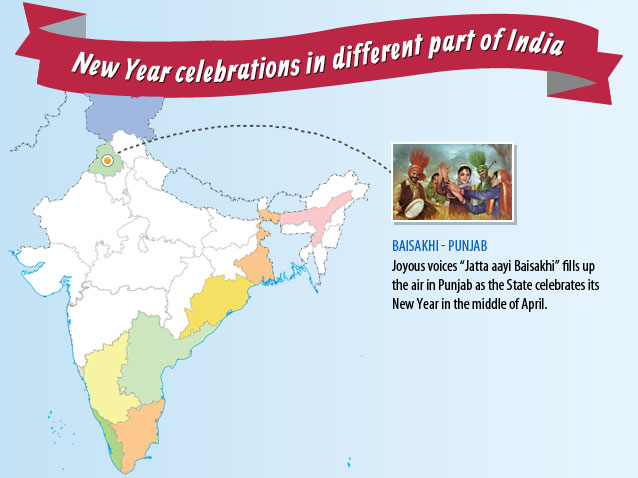
Baisakhi is the most important festival celebrated in the Punjab region. The Baisakhi festival coincides with the Mesha Sankranti which is the Vernal equinox.
Due to calendar irregularities, Baisakhi is celebrated on the 13th or the 14th of April every year. This festival apart from the harvesting part of it is most important to the Sikh community as it marked the very important occasion of the formation of the Khalsa.
History of Baisakhi
Baisakhi is basically the celebration of the formation of Khalsa of the Sikhs. The 9th Guru of the Sikhs, Guru Teg Bahadur, attained martyrdom in the hands of the Mughal emperor Aurangzeb, when he was publicly beheaded as he stood in the path of the Mughal ruler’s ambition plan of converting the whole of India to Islam.
Post the death of Guru Teg Bahadur, Gobind Singh became the next Guru of the Sikhs. In an effort to instill courage and faith amongst his followers, Guru Gobind Singh, asked all his followers to convene on the 30th of March, 1969 to Keshgarh Sahib near Anandpur.
When all the people had congregated, Guru Gobind Singh gave a stirring speech about fearlessness and self sacrifice. He finally called out for someone who was willing ro sacrifice oneself. On the third call a young man offered himself. Guru Gobind Singh took him inside the tent and came out with a bloodied sword. He again called out for another volunteer.
This continued for another three times till he had taken 5 people inside a tent. People gathered had started to worry if these people had been killed or not, when the Guru came out with the 5 men, who now wore saffron robe and turban. These 5 men came to be known as Panj Piara or the Beloved Five of the Guru, who were willing to sacrifice themselves for the sake of the Guru. They received the Guru’s blessing with a Pahul ceremony. The Guru stirred some batasha, a kind of sweetmeat that his wife Mata Sundari ji had given in an iron vessel with a sword called the Khanda Sahib with water. The congregated people kept reciting scriptures as the guru created with sweet water which he now called Amrit, or the nectar of immortality. The Guru offered it to the Panj Piaras first, then he himself had it and post that distributed it amongst the congregated people. With this ceremony,all those who were present, irrespective of their race, culture or caste became the members of Khalsa Pant or the Sacred Path.
The Panj Piaras were considered to be the embodiment of the Guru himself and every Sikh was given the surname of Singh, or the lion. this is one of the best measures of social revolution as in one go, Guru Gobind Singh did away with the caste system as his Panj Piyara constituted people from all castes. Also in a time of dissent, he gave everyone an uniform surname which is actually s great step towards the national integration, as society was then divided on the basis of race, caste and religion. He directed the Sikhs to wear the five K s- kanga or comb, sport K or long hair,Kachcha or shorts,Kripan or daggers and Kara or a bracelet. The Guru Granth Sahib was to be their eternal spiritual guide and the Sikhs were all to be one.
Baisakhi celebration by the Sikhs
Baisakhi is celebrated with great devotion by the Sikhs. The main festivities take place in Talwandi Sabo where Guru Gobind Singh stayed, and Anandpur sahib and in the Golden Temple. On this day, the Sikhs take an early bath, wear new clothes and congregate on the nearest Gurdwaras, or their sacred temple to offer special prayers of this day. After the pujan and Kirtan are over, people are given Prasad of Kada Prasad, which is sweet semolima. People all join for lunch on this day at the Langar, which is prepared by the Kar Sevak s or the volunteers. Throughout the cities, nagar kirtan is carried out in processions, where people participate with a lot of devotion. Later in the evening, people visit each other and exchange greetings of this important day.
Baisakhi celebration by the farmers
The Baisakhi is observed by the farmers almost as a Thanksgiving Day to the almighty for having given a fantastic harvest. This is an important period as it marks the time for the harvesting of the Rabi crops. They pay their tribute to God and also seek his blessings for the future. The day is colorful and vibrant and resonates with laughter and gaiety. Cries of “Jatta Ayi Baisakhi” or that the Baisakhi has come fills the air and colorfully dressed men women and children go to the beautiful fields to celebrate the bounty that God has bestowed. Traditional folk dances like Bhangra and Gidda are performed by men and women in gay colorful dresses with the resounding beats of the dhol. In various places Baisakhi Mela or fairs are also held, where people throng for fun and entertainment,
Baisakhi is not only celebrated in the various parts of India, but also abroad, where the Sikh communities have settled down. Some examples are the United Kingdom, Canada, South Eastern Asian countries etc.